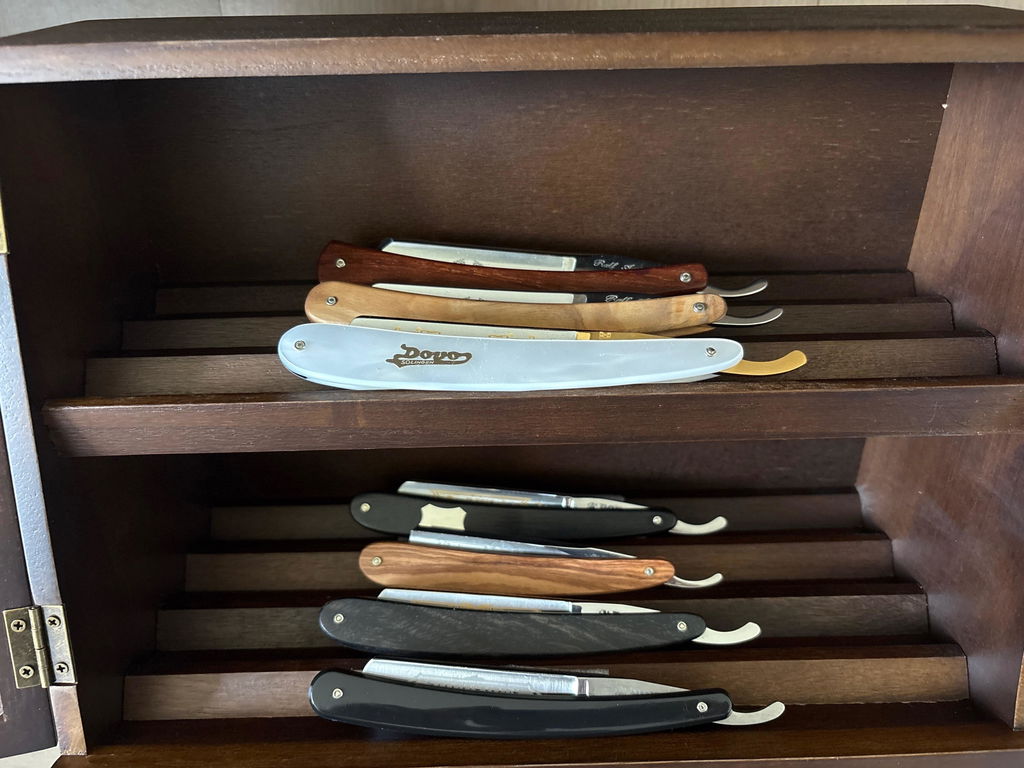





Choosing your first straight razor often feels like a high-stakes decision. You are looking at beautiful pieces of German or French steel and wondering if a fraction of an inch really changes how the razor behaves on your skin. At The Classic Edge, we see this hesitation every day. Most men worry about two things: cutting themselves with a blade that is too big or buying a "starter" razor they will want to replace in six months.
The truth is that both the 5/8" and 6/8" widths are professional-grade tools. Neither is a "toy" or a "disposable" version of the other. However, the physical way they interact with your jawline, your vision in the mirror, and the thickness of your hair is quite different. Understanding these nuances ensures you invest in a tool that turns a chore into a ritual you actually enjoy.
Understanding Straight Razor Blade Sizes
When we talk aboutstraight razor blade sizes, we are measuring the width of the blade from the top of the spine down to the sharpened cutting edge. This measurement is almost always expressed in eighths of an inch. While you might see tiny 3/8" blades for detailing or massive 8/8" "meat choppers" for collectors, the 5/8" and 6/8" are the undisputed kings of the modern shaving world.
The width affects three main factors: weight, visibility, and lather capacity. A wider blade is naturally heavier because it contains more steel. That weight can be your best friend or your worst enemy depending on how steady your hands are. A narrower blade allows you to see exactly where the edge is touching your skin, which is a massive relief when you are learning to navigate the sensitive skin around your neck and ears.

The 5/8" Blade: The Precision Specialist
The 5/8" width is widely considered thebest razor width for beginners. There is a very practical reason for this. When you hold a razor at the proper 30-degree angle against your cheek, the spine of a 5/8" blade sits closer to your face than a 6/8" would. This lower profile makes it much easier to see the cutting edge in your bathroom mirror.
If you are worried about the "fear of the unknown," starting with a 5/8" helps remove the blind spots. You can see your sideburn lines and the area under your nose with much more clarity. This size is exceptionally nimble. If you have a face with sharp angles, a prominent chin, or a thin neck, the 5/8" moves through those "tight spots" without feeling like you are wielding a broadsword.
Furthermore, a 5/8" blade is lighter. For someone just starting out, hand fatigue is real. Learning the muscle memory for a three-pass shave takes time. A lighter razor is often easier to stop and start as you find your rhythm. It doesn't mean it's less effective; a hollow-ground 5/8" razor from a reputable brand like Dovo or Ralph Aust will shave just as close as any other size if it has been properly honed.
The 6/8" Blade: The Heavy-Duty Workhorse
As you move up to the 6/8" blade, you notice the "heft." This extra weight is actually a safety feature for many shavers. Because the razor is heavier, you don't need to apply any pressure. You simply let gravity pull the blade down your face. For men with very thick, coarse, or "wiry" beard hair, the 6/8" provides the momentum needed to slice through the stubble without the blade skipping or tugging.
Another huge advantage is lather capacity. A 6/8" blade has more surface area on the "face" of the steel. This means it can collect more shaved hair and lather before you need to stop and wipe the blade clean. If you have a full beard and only shave your neck and upper cheeks, or if you prefer a very thick, cushiony lather, the 6/8" allows for longer, more continuous strokes.
The 6/8" is also a fantastic choice for longevity and value. Because there is more steel on the blade, it can technically survive more hones over several decades compared to a narrower blade. While a 5/8" will still last a lifetime with proper care, the 6/8" feels like a more substantial heirloom piece in the hand. Many of our customers at The Classic Edge find that once they master the basics, they appreciate the "presence" of the larger steel.
Solving the Maneuverability Problem
The biggest pain point for any new shaver is the neck. The skin is thinner, the hair grows in multiple directions, and the jawbone creates a difficult hurdle. This is where blade width becomes a personal preference. Some find the 5/8" superior here because they can tilt it and turn it into the hollows of the neck more easily.
Others prefer the 6/8" for the neck because the wider blade stays flatter against the skin. If you have a very flat, wide face, the 6/8" might actually be easier for you to use on your cheeks. However, if you have a "craggy" face or like to keep a very specific beard shape, the 5/8" acts more like a scalpel, giving you the surgical precision required to keep those lines sharp.
Longevity and Your Investment
When you browse theSelection of Straight Razors at our store, you will see that prices don't always scale with size. A 5/8" can be just as expensive as a 6/8" because the cost is driven by the quality of the steel, the grind, and the handle (scales) material.
If you are worried about "outgrowing" your razor, don't be. Many veteran shavers keep both sizes in their rotation. They might use a 6/8" on a Monday after two days of growth and a 5/8" for a quick mid-week touch-up. If you are looking for a deal to get started, checking out aSale Page can often help you find a premium 6/8" for the price of a 5/8", making the decision much easier for your wallet.
Maintenance: Does Size Matter for Honing?
One common misconception is that a 6/8" blade is harder to maintain. Whether you are using a 3-inch strop or a smaller travel version, the technique for stropping and honing remains identical for both widths. The spine of the razor acts as your guide. Since the spine is thicker on a 6/8" to maintain the correct geometry for the wider blade, the sharpening angle stays the same.
You won't need different equipment for either size. Both require a good leather strop and eventually a trip back to a professional honer. At The Classic Edge, we make sure every razor—regardless of its width—is hand-honed by Phil before it leaves our shop. This ensures that your "Fear of the Unknown" doesn't include a dull blade. You can read more about general shaving mechanics and the importance of a sharp edge on reputable hobbyist sites likeThe Art of Manliness.

Which One Should You Buy?
To make this simple, we have broken it down into a few specific scenarios:
-
Choose the 5/8" if: You have never used a straight razor before, you have sensitive skin, you have a thin or angular face, or you want the most visibility possible in the mirror.
-
Choose the 6/8" if: You have very coarse or thick beard hair, you prefer a heavier tool that does the work for you, or you are looking for that classic "barber shop" feel and weight.
Regardless of the width, the most important factor is that the razor is "Shave Ready." Most factory-made razors are only "factory sharp," which is not the same thing. When you buy from a specialist, that blade has been tested and refined so your first experience is smooth rather than scratchy.
Final Thoughts on Blade Selection
Selecting a blade width is a journey toward finding your own perfect shave. There is no wrong answer, only the answer that feels right in your hand and on your face. Start with the size that gives you the most confidence. If you want a nimble, easy-to-see tool, go with the 5/8". If you want a powerful, heavy-duty cutter, go with the 6/8". Both will provide a level of closeness and satisfaction that a plastic cartridge razor simply cannot match.
FAQs
- Is a 6/8" razor more likely to cut me than a 5/8"? No. A cut usually happens due to poor angle, too much pressure, or a dull blade. The width of the steel doesn't make it more dangerous, but the 6/8" is heavier, so you must be more mindful of letting the weight of the razor control the stroke.
- Can I use a 3-inch strop for both sizes? Yes. A 3-inch strop is wide enough to accommodate the full length of most 5/8" and 6/8" blades, meaning you don't have to use a "diagonal" or X-stroke pattern as much. Both sizes fit perfectly on standard stropping equipment.
- Why is 5/8" recommended for beginners?It is recommended mainly for visibility and balance. Beginners often struggle with seeing exactly where the blade meets the skin. The narrower profile of the 5/8" keeps the spine out of your line of sight, making it easier to learn the correct 30-degree angle.
- Does a wider blade mean a closer shave?Not necessarily. The closeness of a shave depends on the sharpness of the edge and your technique. A 6/8" might feel like it shaves "easier" through thick hair because of its momentum, but both sizes are capable of achieving a perfectly smooth finish.